

When families first hear about Applied Behavior Analysis (ABA) therapy, they often picture structured lessons at a desk using flashcards or tabletop activities. While structured teaching has its place, many children with autism learn best through real life experiences that feel natural and meaningful. That is where Natural Environment Teaching (NET) comes in.
NET uses everyday activities and routines to teach skills in the environments where children actually use them. Instead of practicing skills only in a controlled setting, children learn while playing, getting dressed, eating meals, going to the park, or interacting with family. This helps skills become functional, flexible, and long lasting.
NET is an ABA teaching approach that uses naturally occurring opportunities to teach and reinforce skills. The therapist follows the child’s motivation and interests, then embeds learning targets into activities that are already fun and meaningful. Examples include:
NET teaches children how to use skills in real situations, not just during structured practice.
Both NET and structured teaching are important in ABA, but they work differently.
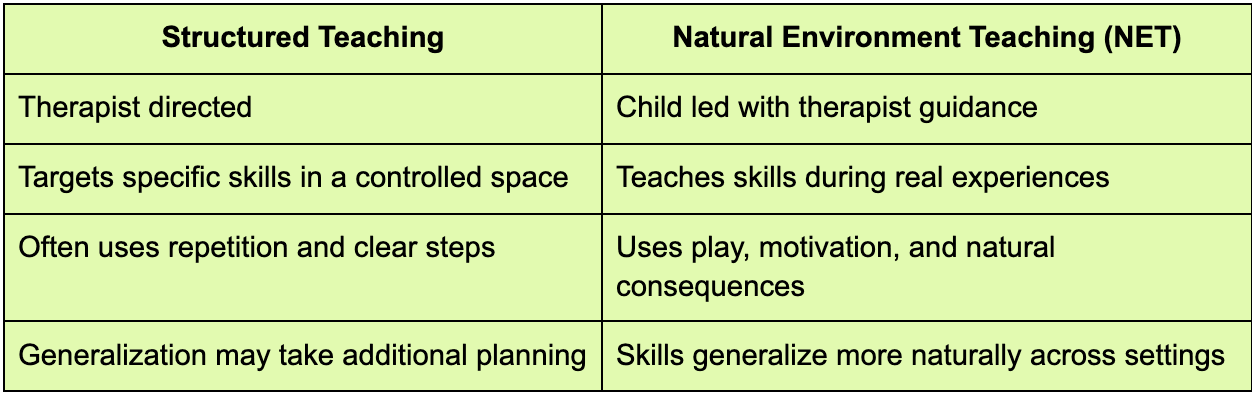
NET feels more like play, but it is highly intentional and guided by a clinical plan.
NET helps children:
Research shows that when children learn skills in natural settings, they are more likely to use them consistently and independently in everyday life.
NET can support a wide range of developmental areas, such as:
NET is especially effective for younger children or children who learn best through movement and hands on activities.
A child wants grapes but does not yet request verbally. The therapist holds the container and waits for the child to communicate. The child may point, gesture, or say a word. The therapist reinforces the attempt by giving a grape. The child learns that communication has power.
A child struggles to leave the park without crying. The therapist uses visual schedules, counting, or a break card to prepare the transition and reinforce calm behavior. The child learns emotional coping through practice in real life settings.
During block building, the therapist supports turn taking and sharing. Instead of a worksheet on social skills, the child learns through meaningful interaction. NET makes goals relevant to the child’s everyday world.
NET is flexible and occurs where learning naturally happens. For example:
For Colorado families, NET can be especially valuable for practicing skills in outdoor environments like trails, playgrounds, and family outings.
Parents play a valuable role in NET because they participate in real life teaching moments that happen beyond scheduled therapy hours. ABA therapists coach parents to apply strategies during daily routines, helping skills stick. When parents understand and use NET, they gain confidence and consistency, which strengthens progress.
NET works for many children, but it is often most helpful for:
At Kiwi Kids ABA, we believe children learn best when therapy feels meaningful and connected to real life. Our approach includes Natural Environment Teaching to help children build independence, confidence, and everyday functional skills. We work closely with families to identify goals that matter most and embed those goals into daily routines and activities.
If you want to learn more about how NET can support your child’s development, contact Kiwi Kids ABA to schedule a consultation.
Our team of experienced therapists is dedicated to helping children with autism and other developmental disabilities reach their full potential. We are committed to creating a supportive and nurturing environment where every child can thrive.
Contact us today to learn more about our services and how we can support your child's development.